Met Gala 2026 – Art, Textiles, and Storytelling on the Global Stage
May 10, 2026 · Tripti Gore Chandorkar

Table of Contents
- Introduction
- Highlights of Indian Designer Outfits at the Met Gala 2026
- How This Year’s Met Gala Brought Me Back to Xiang Li’s Watercolor-on-Silk Paintings
- Closing Thoughts
Introduction
Every year, the Met Gala produces spectacle. There is drama, excess, commentary, performance. But every once in a while, amidst the flash of celebrity culture, something deeper emerges.
This year felt different to me.
The theme of the 2026 Met Gala was “Costume Art,” tied to the Metropolitan Museum of Art Costume Institute’s exhibition of the same name. The official dress code was “Fashion Is Art.” The exhibition explored the idea of the “dressed body” — treating fashion not merely as clothing, but as sculpture, performance, painting, and conceptual art.
And for perhaps the first time in a long while, fashion at the Gala truly seemed to lean into that idea completely. So many looks this year moved beyond glamour and into artistic expression:
- sculptural silhouettes
- wearable paintings
- surrealist body forms
- theatrical capes and sweeping trains
- couture inspired by museum objects and fine art
- garments that looked almost like moving installations
Given my Indian background, I found myself especially drawn to what the Indian guests chose to wear this year. As I looked at the striking ensembles of Karan Johar, Sudha Reddy, and Diya Mehta Jatia at the Met Gala, I found myself thinking less about “fashion” in the conventional sense and more about textiles as narrative.
About fabric as memory. About clothing as cultural manuscript.
Highlights of Indian Designer Outfits at the Met Gala 2026
What struck me most was not simply the grandeur of what they wore, but the intentionality behind it. These were not merely garments designed to impress on a red carpet. They felt closer to curated visual essays about India’s artistic inheritance.
Karan Johar’s Met Gala look drew inspiration from the celebrated Indian painter Raja Ravi Varma from the late 19th century, whose work famously blended Indian mythology, royal portraiture, and European realism. Designed by Manish Malhotra, the outfit felt almost like a moving Ravi Varma canvas — transforming textile and silhouette into a dramatic tribute to India’s artistic and cultural heritage.
View this post on Instagram
Sudha Reddy’s Met Gala ensemble, titled “The Tree of Life,” drew deeply from the ancient South Indian tradition of Kalamkari textile art and the cultural heritage of Andhra Pradesh and Telangana (states in India). Again, designed by Manish Malhotra, the look transformed fabric into a narrative canvas — weaving together temple iconography, celestial motifs, peacocks, and traditional symbolism into a monumental couture piece that felt less like a gown and more like a living textile archive.
View this post on Instagram
Diya Mehta Jatia’s Met Gala ensemble drew inspiration from India’s traditional Shola craft of Bengal and the rich silk heritage of Kanjeevaram weaving from South India. Designed by Mayyur Girotra, the look transformed endangered regional craft traditions into sculptural couture — turning the garment into a powerful artistic conversation between textile, architecture, and cultural memory.
View this post on Instagram
How This Year’s Met Gala Brought Me Back to Xiang Li’s Watercolor-on-Silk Paintings
These spectacular outfits, in a very unexpected way, they made me think deeply about Xiang Li’s watercolor-on-silk paintings.
At first glance, the connection may seem unusual. One belongs to the world of couture and celebrity spectacle; the other to fine art rooted in classical Chinese traditions. Yet the more I reflected on it, the more the connection felt undeniable.
Because both are ultimately exploring the same profound idea: That textile itself can become an artistic medium for storytelling.

For centuries, civilizations across Asia never treated cloth as merely functional. Textiles carried status, mythology, spirituality, dynastic identity, craftsmanship, regional memory, and aesthetic philosophy.
Silk routes were not merely routes of commerce – they were routes of symbolism, artistic exchange, and cultural imagination.
In India especially, fabric has always spoken. A Banarasi weave, a Paithani sari, a Chikankari motif, a Kanjeevaram silk border — these are not merely decorative traditions. They are archives: living repositories of labor, craftsmanship, migration, ritual, geometry, ecology, and memory. Even today, silk sarees and intricately crafted bridal garments are treasured as heirlooms, lovingly passed down from one generation to the next — from mother to daughter — carrying not only beauty, but family history and emotional continuity within their folds.

And this year at the Met Gala, I felt some of that spirit return.
There was a deliberate theatricality in the way Indian craftsmanship was presented, not minimized, not diluted, not quietly adapted for Western approval. Instead, it occupied space boldly. Monumentally. Almost ceremonially.
The garments seemed to say:
We are not here merely to participate in fashion.
We are here to bring an entire civilizational language into the room – and onto the global stage.
For similar reasons, I have always found Xiang Li’s watercolor-on-silk paintings so compelling because the silk itself is not incidental. The material matters. The translucency matters. The softness matters. The way pigment settles into silk creates an emotional atmosphere that would not exist on canvas in quite the same way. The medium itself becomes part of the artwork.
When I look at her Chinese empress paintings, I feel that I am not simply looking at a painting. I am looking through layers of cultural memory carried by silk itself, a material that historically moved across kingdoms, courts, ceremonies, trade routes, and artistic traditions throughout Asia.
And suddenly, while watching this year’s Met Gala unfold, I could almost imagine Xiang Li’s paintings transforming into couture. A sweeping silk cape carrying an entire misty landscape like a moving scroll painting. A flowing saree where delicate watercolor portraits emerge softly through layers of cream silk, golden thread and pearls!


This would be fashion not in the commercial sense. But fashion as artistic storytelling. Fashion as cultural narrative and as moving art.
What fascinated me the most was how naturally the Gala’s theme aligned with ideas that have existed within Asian artistic traditions for centuries. In Eastern cultures like India, China and Japan, the boundaries between art, textile, craftsmanship and identity were never rigid to begin with. In Asia, wearable art is not a modern invention at all. The hanfu, the kimono, the sari, the embroidered panel, the silk scroll, the woven motif on a shawl – all existed somewhere between utility and art objects. Somewhere between fashion and philosophy.
Closing Thoughts
In today’s hyper-digital age, where imagery moves rapidly and trends disappear overnight through the cycle of fast fashion, I think there is something deeply powerful about artists and designers returning to textile traditions with seriousness and reverence — not as nostalgia, but as continuity of cultural language and artistic preservation. To me, beneath the spectacle of this year’s Met Gala was a reminder that fashion, at its highest level, can become something far more meaningful than consumption.
Read more about this year’s buzz of Indian art and crafts at the Met Gala 2026 here.
About the author
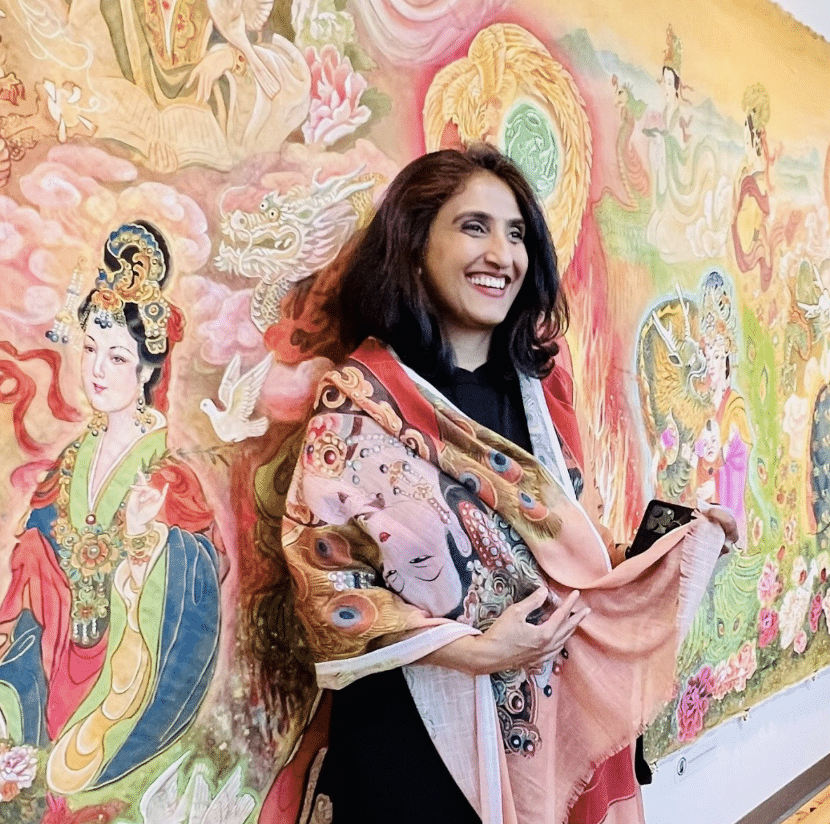
Tripti Gore Chandorkar, the creator and writer behind “triptiji,” launched her blog to celebrate her passion for art, creative projects, and connections with family and friends. With a lifelong love for fine art and writing, Tripti has woven art into her daily life as an enthusiast and hobbyist. Seventeen years ago, her friend Fei Wu introduced her to the artwork of Xiang Li (Fei’s mom), a master artist showcased at xiangliart.com. Since then, Tripti has joined in contributing to Li’s blog, collaborating on designs, and participating in festivals, events, and gallery shows. Through “triptiji,” she shares her journey in the art world and her dedication to supporting other female artists.
More about Tripti