Xiang Li’s Reimagined Vision of the Women of the Dream of the Red Chamber – From Suffering to Transcendence of 100s of Goddesses
March 11, 2025 · Tripti Gore Chandorkar

Art has always been a medium through which history, literature, and emotion intertwine. Few works exemplify this as profoundly as Xiang Li’s Dream of the Red Chamber paintings collection, in which she painted all 413 characters from the famous Chinese novel over a period of 10 years (1875 – 1985). She was only 32 when she finished the entire series. I have also written about this extraordinary artistic project by Xiang Li’s in a previous blogpost.
What if I told you that there is a part two of this extraordinary artistic accomplishment, an equally astonishing (if not more) monumental piece of art by Xiang Li? During the New Year celebration of 2025, I got to witness her 12-meter-long Chinese watercolor silk scroll based on the women from the story of the Dream of the Red Chamber.
In this painting called 100s of Goddesses, artist Xiang Li has visualized the legendary ‘final vision’ of the story’s protagonist Jia Baoyu (a male character). This one-of-a-kind artwork, completed by Xiang Li in the 1980s after ten years of meticulous work, stands as a landmark piece in contemporary Chinese art with an unparalleled visual tribute to one of the greatest literary classics of all time.
A quick note to my readers that I have not had the opportunity to read the Dream of the Red Chamber although I am very inspired to read it after seeing Xiang Li’s visual interpretations. Much of the information I have presented in this blog post is based on my research of various online sources and Xiang Li’s version of the story.


A Vision of Liberation: The Women of the Red Chamber Reimagined
Baoyu’s ‘final vision’ is a beautifully haunting and philosophical moment, bringing the novel full circle. His first dream or vision in an earlier chapter of the book has many goddesses introducing him to desire, temptation and suffering, while his last vision in the book has the same Goddesses freeing him from earthly desires and suffering, finally leading him to a state of transcendence.
The Meaning of the Final Vision
- Illusion vs. Reality: The entire story of Dream of the Red Chamber is revealed to be an illusion, as Baoyu realizes that everything—love, family, success—is fleeting.
- The Tragic Fate of Women: Baoyu’s final vision reaffirms the suffering of the women he loved, highlighting the novel’s deep sympathy for female struggles.
- Spiritual Awakening: By seeing through the illusions of life, Baoyu achieves enlightenment and chooses a path of spiritual transcendence, in line with Buddhist and Daoist teachings.
In the end, Dream of the Red Chamber leaves readers with a sense of profound sadness for all the characters, yet also a deep spiritual victory for the male protagonist. However all the women who suffered tragic fates in this story have not been depicted to attain transcendence in the novel.
Artist Xiang Li, reinterprets this narrative, offering a new perspective through her breathtaking scroll painting. In her version, the women of the Red Chamber are no longer bound by suffering. Instead, they also achieve enlightenment and finally exist in a state of bliss and transcendence, much like Jia Baoyu in his final spiritual awakening. Through the artist’s brush, we see a realm of divine femininity, where the Twelve Beauties of Jinling and countless other female figures from the novel are freed from earthly pain, engaging in music, dance, and ethereal celebrations.


The leading goddess in this painting
Her name is Qin Keqing (秦可卿), and in her mythical form within Dream of the Red Chamber, she’s represented as “Jinghuan Xiangu” (警幻仙姑), also known as the “Fairy Disenchantment” or “Fairy of Illusory Vision.”
In the novel, Jinghuan Xiangu serves as the guide who leads Jia Baoyu into the dreamlike afterworld realm known as the Land of Illusion (太虚幻境). She introduces him to the destinies of various female characters, symbolizing enlightenment and disillusionment with worldly attachments.

A Historical and Cultural Treasure
What makes this scroll even more extraordinary is the historical significance of its inscriptions. Over the years, it has been signed by some of the most renowned Chinese calligraphers, including:
- Wu Shanmao, Xiang Li’s late husband, a respected calligrapher in his own right.
- Pu Jie – the brother of the last Emperor Pu Yi, marking an imperial connection to the artwork.
- Several now-deceased calligraphy masters, whose contributions immortalize the scroll as a historical artifact as well as a masterpiece of fine art.


The Rarity and Exclusivity of the Scroll
Few artworks in modern Chinese history can claim the uniqueness and exclusivity of Xiang Li’s scroll:
- Size & Scale: At 12 meters by 0.8 meters, this painting is an exceptionally large-scale piece, requiring specialized preservation and display.
- Decades of Work: Xiang Li dedicated over ten years to the piece, ensuring that every detail—each goddess, each movement of the brush—was perfected.
- Exclusive Provenance: With its royal and calligraphic endorsements, the scroll is not only a work of artistic genius but also a rare collectible of immense cultural value.


The hand roll has its own “sleeve” made of red silk, with the Chinese title “100s Goddesses”.
A Once-in-a-Lifetime Viewing Experience

In January 2025, I had the opportunity to see this legendary scroll in person at the artist’s home. The experience was nothing short of mesmerizing. The details of the gold-lined phoenix feathers, the fluidity of the celestial garments, and the expressive faces of the goddesses create a vision of harmony and heaven that feels almost alive.
To witness the 100s of goddesses in their enchanted celestial realm is to step into a world where literature, emotion, and art blend seamlessly. It is not merely a painting, but an invitation to experience an alternate ending—one where the women of the Red Chamber are not left behind in suffering, but instead achieve their own enlightenment!
Final Thoughts
Xiang Li’s scroll is a masterpiece that defies time, merging the sorrowful poetry of the past with the limitless imagination of art. It is not just a reinterpretation of Dream of the Red Chamber. It is a bold reimagining of fate itself—one in which the women, too, can claim their place in transcendence. And that reimagined ending in favor of women-kind also makes this work of art extremely special for me!
In my opinion, this historic, signed, and irreplaceable painting remains an unparalleled treasure —a testament to both Xiang Li’s genius and the enduring legacy of the Red Chamber’s women.
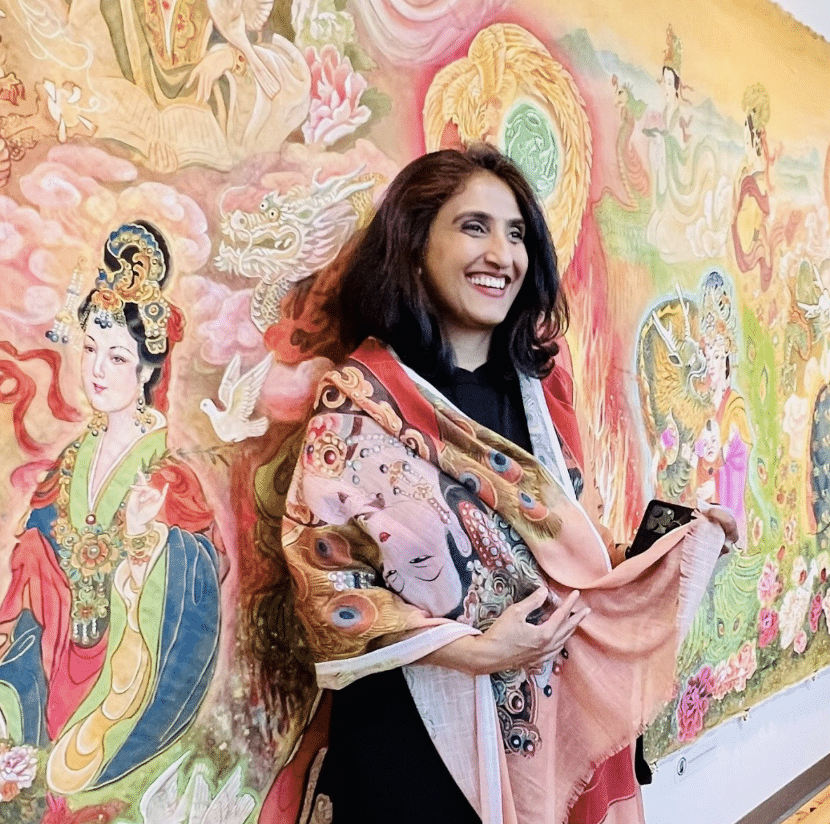
About the author
Tripti Gore Chandorkar, the creator and writer behind “triptiji,” launched her blog to celebrate her passion for art, creative projects, and connections with family and friends. With a lifelong love for fine art and writing, Tripti has woven art into her daily life as an enthusiast and hobbyist. Seventeen years ago, her friend Fei Wu introduced her to the artwork of Xiang Li (Fei’s mom), a master artist showcased at xiangliart.com. Since then, Tripti has joined in contributing to Li’s blog, collaborating on designs, and participating in festivals, events, and gallery shows. Through “triptiji,” she shares her journey in the art world and her dedication to supporting other female artists.
More about TriptiYou might also like…
- Dream of the Red Chamber
- Dream of the Red Chamber: The First Complete Art Collection Created by Visionary Watercolor Artist Xiang Li (400+ Paintings)
- Zhou Ruchang (周汝昌) comment on the Dream of the Red Chamber
- A Heartfelt Letter from Qingshan Zhang for Xiang Li’s Dream of the Red Chamber Exhibition Opening