Empress Xiaoyuan
“Commonly known as Grand Empress Dowager Wang (who lived to the age of 83)”
Her Story
Explore this speaking portrait created using D-ID
Click the play ▶ button, or anywhere on the painting below to start listening.
Wang Zhengjun (Chinese: 王政君; 71 BC – 3 February 13 AD), officially Empress Xiaoyuan (孝元皇后), later and more commonly known as Grand Empress Dowager Wang, born in Yuancheng (modern Handan, Hebei), was an empress during the Western Han dynasty of China, who played important roles during the reigns of five successive Han emperors (her husband, son, two stepgrandsons, and stepgreat-grandnephew) and later (according to traditional historians, unwittingly) led to the usurpation of the throne by her nephew Wang Mang.
She was empress to Emperor Yuan of Han (Liu Shi 劉奭; 75 BC – 8 July 33 BC) was an emperor of the Chinese Han dynasty. He reigned from 48 BC to 33 BC. Emperor Yuan promoted Confucianism as the official creed of the Chinese government. He appointed adherents of Confucius to important government posts.
Empress Xiaoyuan is largely viewed sympathetically by historians as an unassuming and benevolent if overly doting woman who suffered much in her long life, who tried to influence the empire as well as she could, and tried to use her power for the benefit of the empire, and who was not a party to her nephew’s machinations, but whose failure, leading to the downfall of the Western Han Dynasty, was her overdependence on her clan (the Wangs).
Wang Zhengjun (71 BC – 13 AD) was an Empress during the Western Han Dynasty of China and the wife of Emperor Xuan. Known for her beauty and intelligence, she was born into a prestigious family and married Emperor Xuan at a young age, later becoming his Empress.
Her Spouse
Emperor Yuan of Han 漢元帝 (Liu Shi 劉奭; 75 BC – 8 July 33 BC) was an emperor of the Chinese Han dynasty. He reigned from 48 BC to 33 BC. Emperor Yuan promoted Confucianism as the official creed of the Chinese government. He appointed adherents of Confucius to important government posts. However, at the same time that he was solidifying Confucianism’s position as the official ideology, the empire’s condition slowly deteriorated due to his indecisiveness, his inability to stop factional infighting between officials in his administration, and the trust he held in certain corrupt officials.
About this Portrait
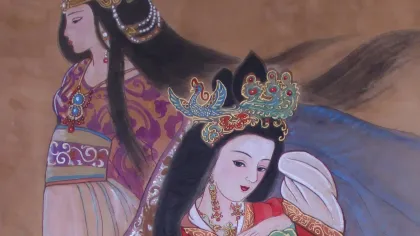
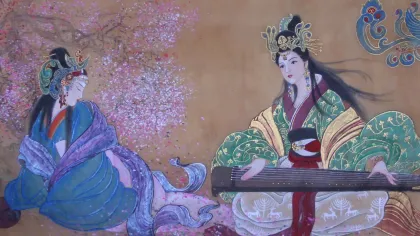
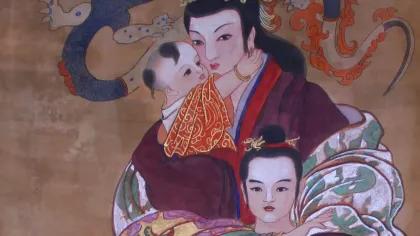
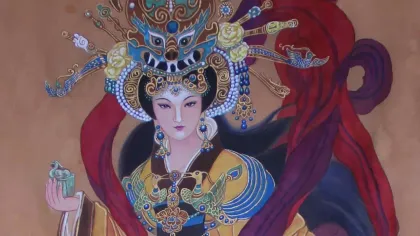
Chinese watercolor, on silk. The Chinese Empresses Collection
Painted by Xiang Li
75 x 36 inches

More from Xiang Li Art

Wang Mang

Empress Xiaoping (Empress Wang)

Empress Fu

Empress Wang (Xin)

Empress Xiaoyuan

Empress Chen Jiao and Empress Wei Zifu

Empress Bo and Empress Wang Zhi

Empress Dou (Empress Xiaowen)

Empress Xiao Hui (Zhang Yan)

BJ Miller

Krista Tippett

Creative Portraits

The Monk (Wen Miao Zhen Ren)

Lin Daiyu

Xue Baocai

Jia Mu

Zhen Shiyin

Shi Xiangyun

Wang Xifeng

Xu Pingjun, Huo Chengjun and Empress Wang Zhengjun

Empress Xu