Empress Wu Zetian
“The first and only woman emperor of China”
Wu Zhao (624–705), also known as Empress Wu Zetian, was the first and only woman emperor of China. With her exceptional intelligence, extraordinary competence in politics, and inordinate ambition, she ruled as the “Holy and Divine Emperor” of the Second Zhou Dynasty (690–705) for fifteen years.
Her Story
Explore this speaking portrait created using D-ID
Click the play ▶ button, or anywhere on the painting below to start listening.
Wu Zetian, also known as Empress Wu, was a remarkable figure in Chinese history. She was born in 624 AD and died in 705 AD. Wu Zetian’s story is unique as she rose from being a concubine to become the only female emperor in Chinese history.
Wu Zetian started her career as a concubine of Emperor Taizong of the Tang Dynasty. After Emperor Taizong’s death, she became a concubine of his son, Emperor Gaozong. Wu Zetian was intelligent and politically astute, and she gradually gained influence over Emperor Gaozong. After Emperor Gaozong suffered a stroke, she effectively took control of the imperial court, becoming the de facto ruler of the Tang Dynasty.
In 690 AD, Wu Zetian seized the throne and declared herself Emperor of the Zhou Dynasty, establishing her own dynasty separate from the Tang Dynasty. She ruled for 15 years before abdicating the throne in favor of her son, Emperor Zhongzong. However, she continued to exert significant influence over the empire even after stepping down.
During her reign, Wu Zetian implemented various political and social reforms, including promoting officials based on merit rather than birth, improving the administration, and supporting Buddhism. She also expanded the empire’s territory through military campaigns and pursued ambitious construction projects.
Wu Zetian’s reign was marked by both admiration and controversy. Some praised her for her intelligence and strong leadership, while others criticized her for seizing power and breaking with the tradition of male emperors. After her death, the Tang Dynasty was restored, and subsequent rulers tried to erase or downplay her legacy.
It’s important to note that historical accounts of Wu Zetian’s reign can vary, as she was a controversial figure, and historical records may be influenced by political biases or later interpretations. Nonetheless, Wu Zetian remains a prominent and fascinating figure in Chinese history.
Recommended reading:
About this Portrait
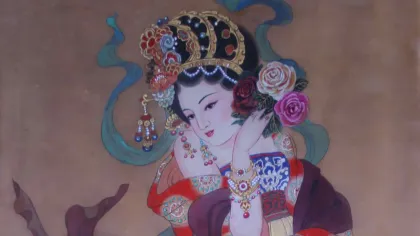
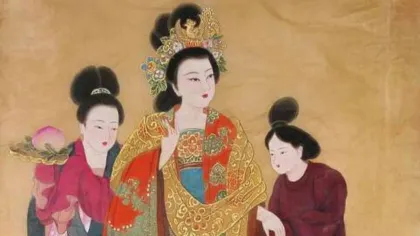
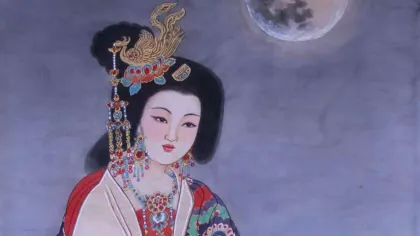
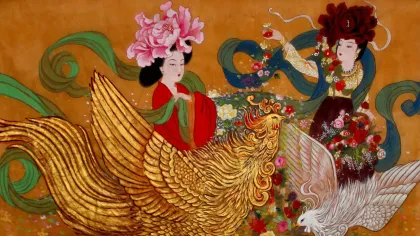
Chinese watercolor, on silk. The Chinese Empresses Collection
Painted by Xiang Li
75 x 36 inches

More from Xiang Li Art

Wang Mang

Empress Xiaoping (Empress Wang)

Empress Fu

Empress Wang (Xin)

Empress Xiaoyuan

Empress Chen Jiao and Empress Wei Zifu

Empress Bo and Empress Wang Zhi

Empress Dou (Empress Xiaowen)

Empress Xiao Hui (Zhang Yan)

BJ Miller

Krista Tippett

Creative Portraits

The Monk (Wen Miao Zhen Ren)

Lin Daiyu

Xue Baocai

Jia Mu

Zhen Shiyin

Shi Xiangyun

Wang Xifeng

Xu Pingjun, Huo Chengjun and Empress Wang Zhengjun

Empress Xu