Chabi, Nambui
https://en.wikipedia.org/wiki/Chabi
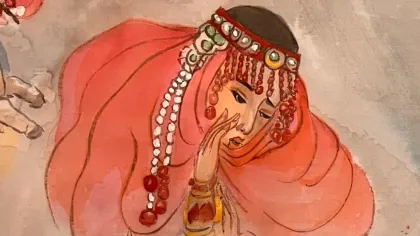
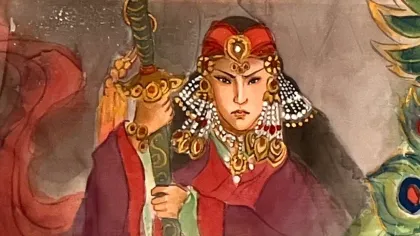
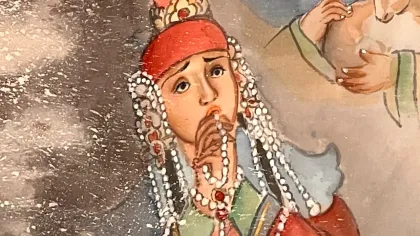
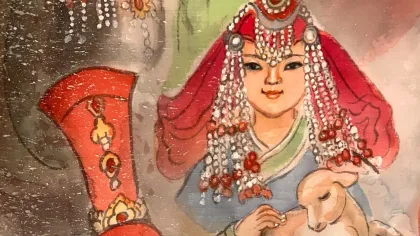
Chabi (c. 1216–1281) was a significant Khongirad empress consort of the Yuan dynasty, married to Kublai Khan. Born to the Prince of Jining zhongwu, Anchen, of the Khongirad tribe, she married Kublai Khan as his second wife, bearing him four sons and six daughters. Beyond her role as a consort, Chabi wielded considerable political and diplomatic influence. She advocated for reconciliation with Confucianism, thereby endearing the Yuan rulers to the Chinese masses. Recognized for her beauty and charm, she also played pivotal roles in political matters, such as warning Kublai Khan about Ariq Böke’s intentions and recommending lenient treatment of the conquered northern Chinese royals. Furthermore, Chabi was a significant patron of Buddhism and mediated religious disputes. Her cultural impact included introducing new court fashion, such as brimmed hats and the bijia, a convenient attire for horse riding. Chabi passed away in 1281 and was posthumously honored by her grandson, Temür Khan, with the title Empress Zhaorui Shunsheng.

Nambui
https://en.wikipedia.org/wiki/Nambui
Nambui, a Khongirad empress consort of the Yuan dynasty, became Kublai Khan’s wife following the death of his first wife, Chabi. Born to Nachen Küregen from the Khongirad tribe, she was Chabi’s niece. After marrying Kublai in 1283, she quickly gained significant influence in the court. Kublai limited his inner circle and often required ministers to relay messages through Nambui. Some sources suggest she might have issued decrees on Kublai’s behalf during the latter part of his reign. Together, they had a son named Temechi. However, both Nambui and Temechi mysteriously disappeared in 1290.
Explore other Yuan Dynasty empresses
Spouse: Emperor Shizu of Yuan
https://en.wikipedia.org/wiki/Kublai_Khan
Kublai, also known as Emperor Shizu of Yuan, founded the Yuan dynasty in China and served as the fifth khagan-emperor of the Mongol Empire from 1260 to 1294. The second son of Tolui and grandson of Genghis Khan, Kublai succeeded his older brother Möngke as Khagan after overcoming his younger brother Ariq Böke in the Toluid Civil War (1260-1264), marking the beginning of the empire’s fragmentation. Though his real power was confined to the Yuan Empire, Kublai’s influence extended to the Ilkhanate and the Golden Horde. In 1271, he officially established the Yuan dynasty, claiming succession from prior Chinese dynasties. Under his rule, the Yuan dynasty ruled over a vast territory encompassing present-day China, Mongolia, Korea, southern Siberia, and adjacent areas. Kublai also attained influence in the Middle East and Europe. By 1279, the Yuan conquest of the Song dynasty was complete, making Kublai the first non-Han emperor to govern all of China proper. The imperial portrait of Kublai, featuring the color white, symbolizing the Five Elements, is housed in the National Palace Museum in Taipei.

More from Xiang Li Art

Wang Mang

Empress Xiaoping (Empress Wang)

Empress Fu

Empress Wang (Xin)

Empress Xiaoyuan

Empress Chen Jiao and Empress Wei Zifu

Empress Bo and Empress Wang Zhi

Empress Dou (Empress Xiaowen)

Empress Xiao Hui (Zhang Yan)

BJ Miller

Krista Tippett

Creative Portraits

The Monk (Wen Miao Zhen Ren)

Lin Daiyu

Xue Baocai

Jia Mu

Zhen Shiyin

Shi Xiangyun

Wang Xifeng

Xu Pingjun, Huo Chengjun and Empress Wang Zhengjun

Empress Xu