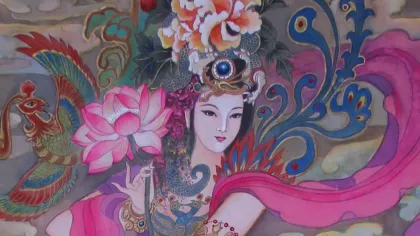
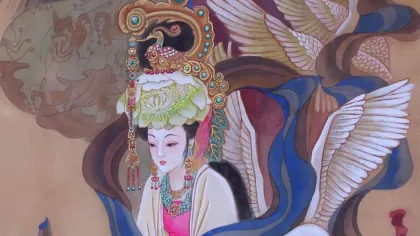
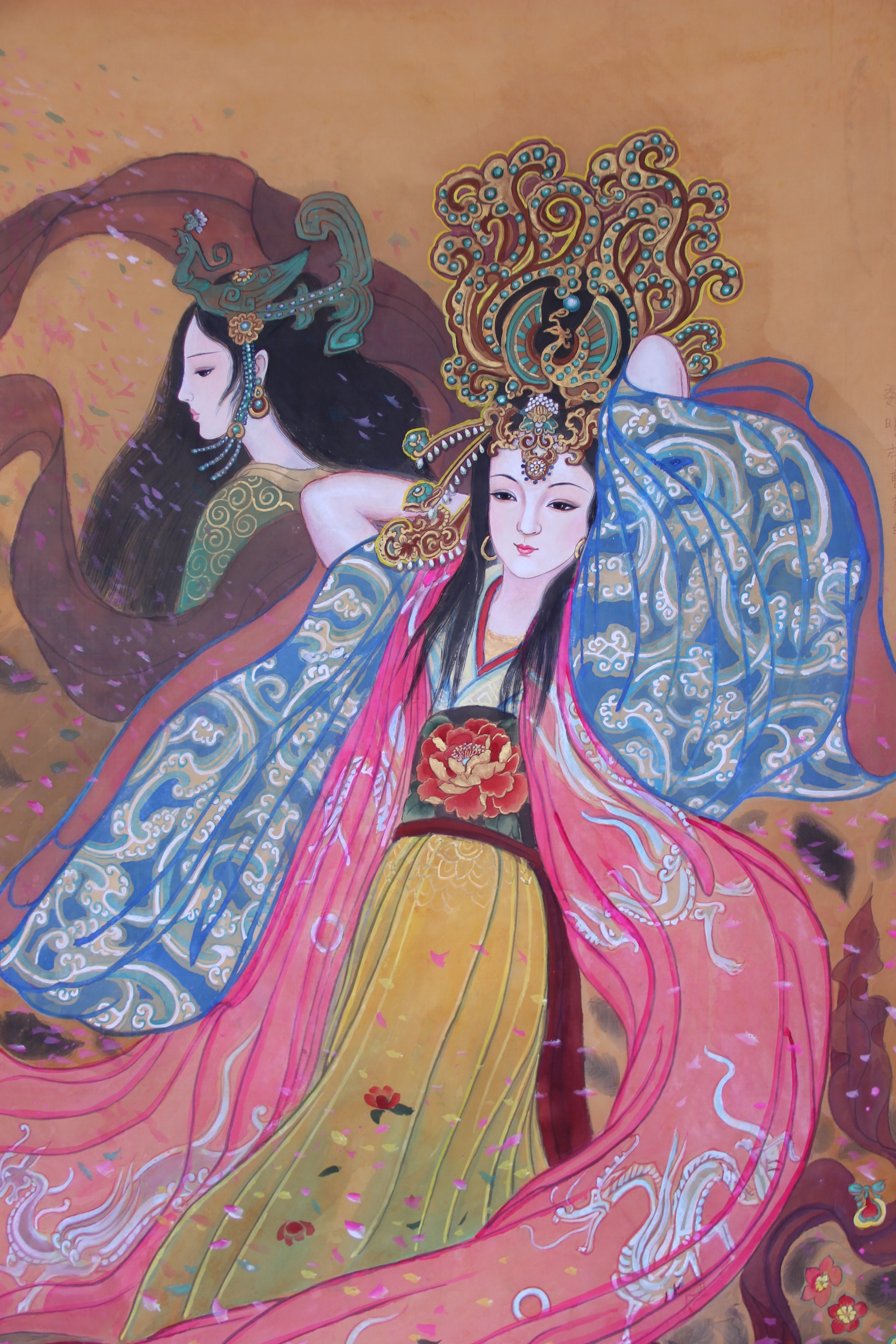
Empress Mao and Empress Guo (Cao Wei)
Artist: Xiang Li
Year: 2022
Medium: watercolor on silk
Dimension: 36×72 in.
About the empresses
Empress Mao (Ming) (died 237 CE), left, was the wife of Cao Rui, Emperor Ming of Wei during the Three Kingdoms period. Known for her virtuous and modest demeanor, she gained favor with the emperor despite not having a noble background. Empress Mao stood out for her loyalty and harmonious relationship with the emperor, avoiding the court intrigues that plagued many of her predecessors. She was deeply mourned by Cao Rui after her early death, indicating her significant personal impact on the emperor and court life.
Empress Guo (died 264 CE), right, was the second wife of Cao Rui, Emperor Ming of Wei, during the Three Kingdoms period. Known for her intelligence and elegance, she was elevated to empress after the death of Empress Mao. Empress Guo wielded considerable influence at court and was deeply trusted by the emperor. After Cao Rui’s death, she maintained her status as empress dowager during the reigns of subsequent emperors but became embroiled in political conflicts.
Spouse: Cao Rui
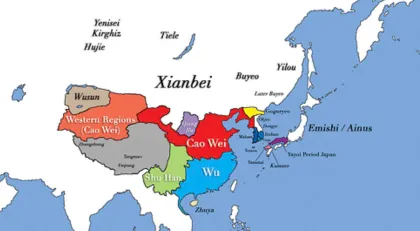
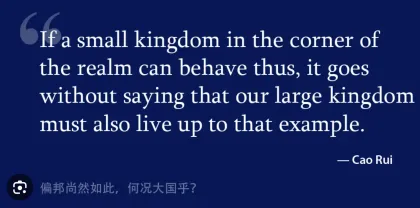
Cao Rui (204 or 205 – 22 January 239), courtesy name Yuanzhong, was the second emperor of the state of Cao Wei during the Three Kingdoms period. His parentage is in dispute: his mother, Lady Zhen, was Yuan Xi’s wife, but she later remarried Cao Pi, the first ruler of Wei. Based on conflicting accounts of his age, Pei Songzhi calculated that, in order to be Cao Pi’s son, Cao Rui could not have been 33 (by East Asian age reckoning) when he died as recorded, so the recorded age was in error; late-Qing scholar Lu Bi and Mou Guangsheng argued instead that Cao Rui was Yuan Xi’s son.
Cao Rui’s reign was viewed in many different ways throughout Chinese history. He devoted many resources to building palaces and ancestral temples, and his reign saw the stalemate between his empire, Shu Han, and Eastern Wu become more entrenched. His building projects and his desire to have many concubines (who numbered in the thousands) greatly exhausted the imperial treasury.
On his deathbed, he has no biological son. He passed the throne to his adopted son Cao Fang and entrusted him to the regency of Cao Shuang and Sima Yi. This would prove to be a fatal mistake for his clan, as Cao Shuang monopolized power and governed incompetently, eventually drawing a violent reaction from Sima Yi, who overthrew him in a coup d’état (Incident at the Gaoping Tombs). Sima Yi became in control of the Wei government from AD 249, eventually allowing his grandson Sima Yan to usurp the throne in AD 266. After his death, Cao Rui was posthumously honored as “Emperor Ming” with the temple name “Liezu”.
More from Xiang Li Art

Wang Mang

Empress Xiaoping (Empress Wang)

Empress Fu

Empress Wang (Xin)

Empress Xiaoyuan

Empress Chen Jiao and Empress Wei Zifu

Empress Bo and Empress Wang Zhi

Empress Dou (Empress Xiaowen)

Empress Xiao Hui (Zhang Yan)

BJ Miller

Krista Tippett

Creative Portraits

The Monk (Wen Miao Zhen Ren)

Lin Daiyu

Xue Baocai

Jia Mu

Zhen Shiyin

Shi Xiangyun

Wang Xifeng

Xu Pingjun, Huo Chengjun and Empress Wang Zhengjun

Empress Xu