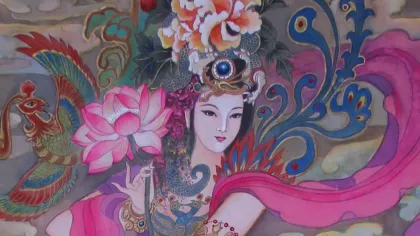
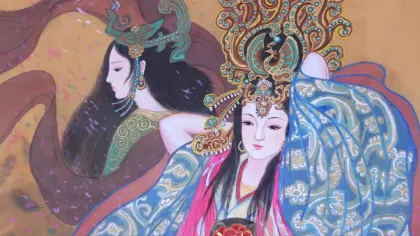
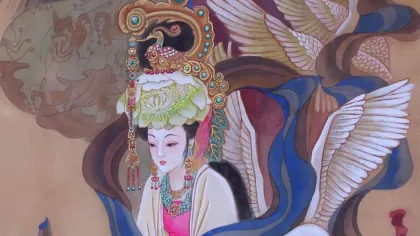
The Three Kingdoms (Eastern Wu) Empresses
Artist: Xiang Li
Year: 2022
Medium: watercolor on silk
Dimension: 24×36 in.
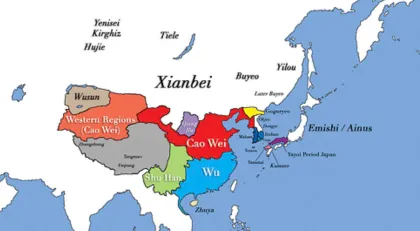
Established by Sun Quan with its capital at Jianye (modern Nanjing), Wu governed the fertile lower Yangtze and coastal regions. Mastery of riverine warfare and a thriving maritime economy sustained the kingdom for decades, while figures like strategist Lu Xun ensured its survival against Wei aggression. Internal succession struggles and Jin’s eventual unification drive, however, culminated in Wu’s peaceful surrender, ending the Three Kingdoms period.

About the empresses:
Bottom right: Empress Pan (251–252 CE) was the wife of Sun Liang, the second emperor of Eastern Wu. Known for her arrogance and cruelty, her behavior alienated the court and led to her downfall. She was deposed in 252 CE after less than a year as empress and subsequently executed.
Bottom left: Empress Quan Huijie (252–258 CE) succeeded Empress Pan as the wife of Sun Liang. Coming from the influential Quan family, her tenure as empress was short-lived due to the political instability of the time. She was deposed when Sun Liang was forced to abdicate in 258 CE.
Middle left: Empress Zhu (262–264 CE) was the wife of Sun Xiu, the third emperor of Eastern Wu. Little is documented about her life or role as empress, as her tenure was brief during a relatively unstable period in the state’s history.
Upper left: Empress Teng Fanglan (264–280 CE), the wife of Sun Hao, the last emperor of Eastern Wu, served during the state’s decline. Despite her position, she held little political influence as Sun Hao’s increasingly tyrannical rule led to the downfall of Eastern Wu. After the kingdom’s annexation by Jin in 280 CE, she retired from public life.
Upper right: Empress Bu Lianshi (died 238 CE) was an empress of Eastern Wu, the wife of Sun Quan, the founding emperor of the dynasty. Renowned for her wisdom, composure, and virtuous character, she served as a trusted confidant and advisor to Sun Quan. Although she was formally honored as empress only after her death, she played a significant role during Sun Quan’s reign, particularly in fostering stability within the court and maintaining harmony among his numerous consorts and children. Her posthumous elevation reflects the respect she garnered during and after her life, symbolizing her enduring influence on the early Eastern Wu court. Empress Bu did not hold the title of empress during her lifetime.
More from Xiang Li Art

Wang Mang

Empress Xiaoping (Empress Wang)

Empress Fu

Empress Wang (Xin)

Empress Xiaoyuan

Empress Chen Jiao and Empress Wei Zifu

Empress Bo and Empress Wang Zhi

Empress Dou (Empress Xiaowen)

Empress Xiao Hui (Zhang Yan)

BJ Miller

Krista Tippett

Creative Portraits

The Monk (Wen Miao Zhen Ren)

Lin Daiyu

Xue Baocai

Jia Mu

Zhen Shiyin

Shi Xiangyun

Wang Xifeng

Xu Pingjun, Huo Chengjun and Empress Wang Zhengjun

Empress Xu